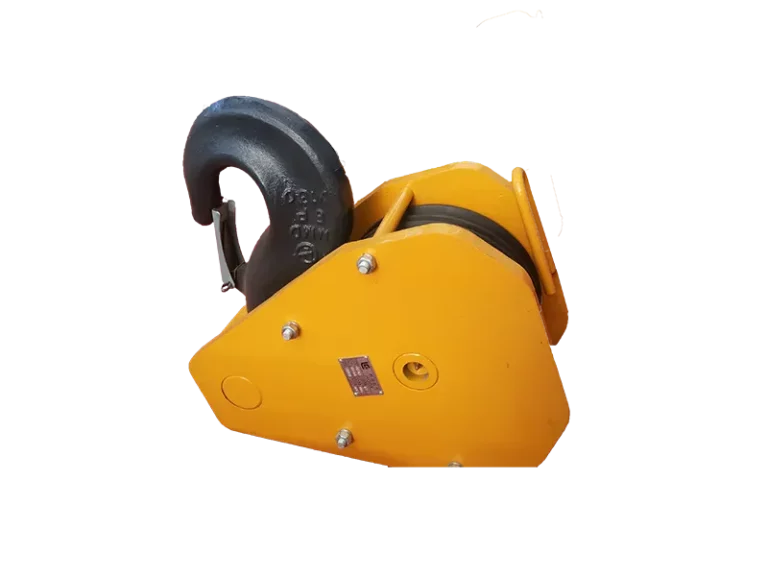
A material-selection guide for engineers who care about the hook that holds everything up
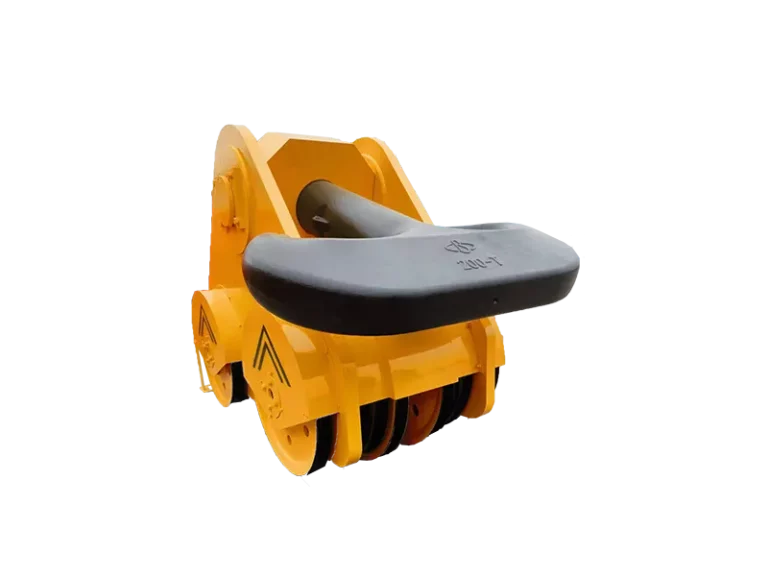
Every crane has exactly one component that carries the entire suspended load, that takes the shock of every lift and every sudden stop, and that — if it ever lets go — turns a routine shift into a catastrophe. That component is the hook. Forging it from the wrong steel is not a minor design choice; it is a decision that trades a known, avoidable failure mode against a small saving in material cost.
Two medium-carbon steels are frequently proposed for forged hooks: 45# steel (C45), the Chinese workhorse of the GB/T 699 series, and SF540A, a carbon-steel forging grade from Japanese standard JIS G 3201. Both are strong, both are cheap, and both are wrong for this application. Here is why.
1. The hook is a safety-critical component
Lifting hooks operate under a combination of conditions that ordinary machine parts never see:
- High static load — the hook must support the full working load limit, plus impact during pick-up.
- Repeated cyclic loading — every lift is a fatigue cycle; hooks are designed for many years of duty.
- Stress concentration — the curved inner throat of the hook concentrates stress by a factor of several times the nominal value.
- Shock and low temperature — dropped loads, swinging loads, and cold-weather operation all push the material toward brittle fracture.
A hook failure is not a warranty claim. It is a dropped load, a crushed worker, or a downed production line. For this reason, the entire selection philosophy is inverted compared to ordinary machine parts: we choose a material that is strong enough, and then we insist that it cannot break suddenly. Ductility, toughness, notch resistance and fatigue behaviour matter more than the last 50 MPa of tensile strength.
2. Standards already give the answer: the same logic in GB/T 10051.1 and DIN 15400
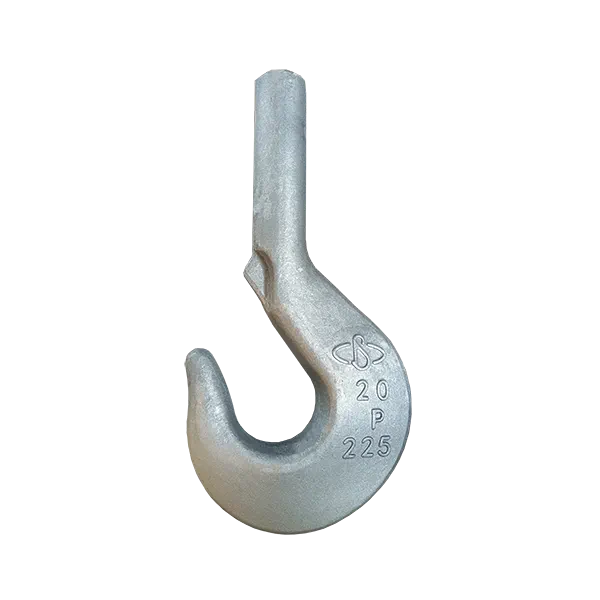
In China, forged crane hooks are covered by GB/T 10051.1-2010, Lifting hooks — Part 1: Mechanical properties, rated lifting capacity, stress and materials. The standard mandates structural and alloy steels for forged hooks — with Q345qD, Q420qD, 35CrMo, 34Cr2Ni2Mo and 30Cr2Ni2Mo as the representative grades — and specifies their mechanical properties and lifting capacities by strength class (M/P/S/T/V). Neither 45# steel nor SF540A appears anywhere on that list.
Europe answers exactly the same way. The German hook standard DIN 15400 (general requirements for lifting hooks) likewise assigns materials and load ratings by strength class M, P, S, T and V:
- Class P — fine-grain structural steels, typically StE 355 / StE 420 (roughly the Chinese equivalents Q345qD / Q420qD), offering good weldability and economical cost for ordinary lifting duty;
- Classes S and T — alloy steels such as 34CrMo4 and 34CrNiMo6 (roughly 35CrMo and 34Cr2Ni2Mo in Chinese grades) for heavy-duty and high-strength hooks;
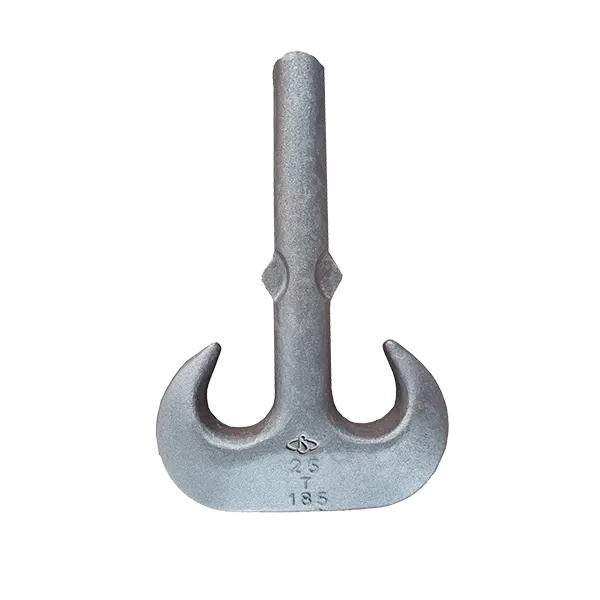
- DIN 15401 (single hooks) and DIN 15402 (double hooks) define the dimensional and capacity series.
The grade mapping between DIN and GB — StE 355 ≈ Q345qD, 34CrMo4 ≈ 35CrMo, 34CrNiMo6 ≈ 34Cr2Ni2Mo — lines up almost one for one. That is the clearest possible sign that the material logic for safety-critical hooks is an international consensus: fine-grain low-alloy structural steels or quenched-and-tempered alloy steels, and no place for ordinary medium-carbon steels such as C45.
Standards are not arbitrary. The material lists in GB/T 10051.1 and DIN 15400 encode decades of experience about what survives in service — and what does not.
3. Why 45# steel (C45) is unsuitable
45# steel is a medium-carbon quality carbon steel (approximately 0.42–0.50 % carbon) defined by GB/T 699. In the normalized condition it delivers a respectable tensile strength ≥ 600 MPa, yield strength ≥ 355 MPa, elongation ≥ 16 %, reduction of area ≥ 40 %, and room-temperature Charpy impact energy ≥ 39 J. On paper, it looks entirely capable. In a forging hook, four characteristics disqualify it:
a) Poor hardenability. The critical quenching diameter of a plain medium-carbon steel is small. A forged hook — which may weigh from a few kilograms to several tons — has a large cross-section, and a plain carbon steel simply cannot be hardened through to the core. The centre of a thick hook section stays as a soft ferrite–pearlite mixture with reduced strength, hardness and toughness, so the property guaranteed by the datasheet exists only near the surface.
b) High quench-cracking risk. With roughly 0.45 % carbon, the martensite transformation produces large quench stresses. The hook’s geometry — abrupt section changes, the curved inner radius, sharp transitions at the shank and lug — is exactly the shape that concentrates those stresses. Quench cracking during heat treatment is a well-known scrap generator with medium-carbon hooks.
c) Notch sensitivity and brittle fracture. The inner throat of the hook is a severe stress raiser. A medium-carbon steel in the quenched-and-tempered condition has limited plastic reserve at the notch root, and under impact, cyclic loading or low temperatures it can fail with little or no visible warning — precisely the failure mode a safety component must never exhibit.
d) Poor weldability. High carbon equivalent makes 45# steel prone to hardened, crack-prone zones when welded. Hooks frequently need repair welding or attachment welds (lugs, retaining rings, load indicators), and a material that cracks under its own weld is a maintenance liability.
4. Why SF540A is unsuitable
SF540A is a carbon-steel forging grade from JIS G 3201, Carbon steel forgings for general purpose machinery (formerly known as SF55A). Its specified properties — tensile strength 540–640 MPa, yield point ≥ 275 MPa, elongation ≥ 20 %, reduction of area ≥ 35 % — are delivered in the normalized or normalized-and-tempered condition.
At first glance SF540A looks like a “nicer” version of 45# steel: forged rather than rolled, with a slightly higher elongation. But the fundamental problem does not go away:
a) It is still a medium-carbon steel forging. SF540A occupies the same strength class as C45 — roughly 0.4 % carbon — and carries the same inheritance: poor hardenability in thick sections, quench-cracking sensitivity in complex geometry, and limited toughness reserve. A forged product shape does not change the metallurgy of a plain medium-carbon steel.
b) The standard specifies no impact toughness. JIS G 3201 gives SF540A a tensile range, yield point, elongation and reduction of area — but no Charpy impact requirement, and no low-temperature notch-toughness requirement at all. For a hook, impact energy and low-temperature behaviour are the very properties that prevent sudden brittle fracture. Contrast this with DIN 15400, which packages material, mechanical properties and load rating together for every strength class: a grade without a guaranteed Charpy value cannot be certified as a lifting-safety material — you would be signing off a safety component on hope rather than on a verified number.
c) It is a general-purpose forging standard, not a lifting-safety standard. JIS G 3201 is written for shafting, pressure-vessel necks and general machinery forgings. It was never intended to cover, and does not impose, the fatigue verification, fracture-safe design margin, or per-part NDT that hook standards require. Certification to the wrong standard is, in safety engineering, the same as no certification.
d) Same notch-sensitivity and weldability issues as 45#. The stress concentration at the hook throat, the cyclic nature of crane duty, and the need for weld attachment all count against a plain medium-carbon forging grade, for exactly the same reasons as with 45# steel.
In short, 45# and SF540A are not two different problems — they are the same problem wearing two different standard numbers: a medium-carbon steel with acceptable strength but insufficient and unverifiable toughness for a safety-critical, notch-sensitive, fatigue-loaded component.
5. Side-by-side comparison
表格
| Property | 45# steel (GB/T 699) | SF540A (JIS G 3201) |
|---|---|---|
| Carbon content | ≈ 0.42–0.50 % | Medium-carbon (same class) |
| Tensile strength | ≥ 600 MPa | 540–640 MPa |
| Yield strength | ≥ 355 MPa | ≥ 275 MPa |
| Elongation | ≥ 16 % | ≥ 20 % |
| Reduction of area | ≥ 40 % | ≥ 35 % |
| Guaranteed Charpy impact | Yes (≥ 39 J, RT) | Not specified |
| Heat treatment | Normalizing or Q&T | Normalizing / N+T |
| Hardening through thick hook sections | Poor (low hardenability) | Poor (low hardenability) |
| Suitability for forged hooks | Not suitable | Not suitable |
| Listed in GB/T 10051.1 / DIN 15400 hook materials | No | No |
6. What should a forged hook be made of instead?
Every credible hook manufacturer — whether working to GB or DIN — follows the same route:
- Low-alloy structural steels (Q345qD, Q420qD) — the Chinese counterparts of DIN fine-grain steels StE 355 / StE 420. Moderate strength, good weldability, reliable toughness; the workhorse for small- and medium-capacity hooks.
- Alloy steels (35CrMo, 34Cr2Ni2Mo, etc.) — the counterparts of DIN 34CrMo4 / 34CrNiMo6, quenched and tempered for large hooks and the higher strength classes, where alloying elements provide the through-hardening that plain carbon steels cannot.
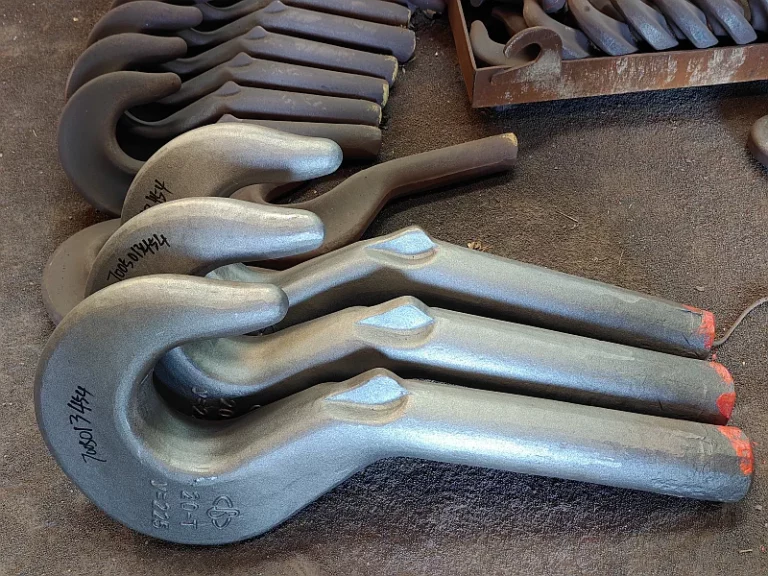
The manufacturing route matters as much as the grade: forging → whole-section heat treatment (quench-and-temper) → full non-destructive testing. The result is a hook whose strength and toughness are verified throughout the section, not just at the surface. International hook standards (such as ISO 17440) reinforce the same philosophy by limiting applicable materials to a tensile strength of not more than 800 N/mm² and a yield stress of not more than 600 N/mm² — the point being to keep strength adequate while making toughness and reliability the priority.
7. Conclusion
A forged lifting hook is the last place in a crane where you want to save money on steel. 45# steel and SF540A both offer attractive tensile numbers and a tempting price tag, but both are medium-carbon steels whose limited hardenability, quench-cracking sensitivity, poor notch toughness and — in SF540A’s case — complete absence of a guaranteed impact value disqualify them for safety-critical lifting service. When the Chinese (GB/T 10051.1), German (DIN 15400/15401/15402) and international (ISO 17440) standards all point the same way, the engineering choice is not a close call: use a tough, low-alloy structural or alloy steel, forge it, heat-treat it as a whole, test it, and only then trust it to hold the load.