How cost, scale, logistics and certification have made China the default supplier for Korea’s lifting hardware
South Korea runs on heavy industry. Its shipyards launch some of the world’s largest vessels, its steel mills and automotive plants run around the clock, and its ports and power stations move enormous loads every day. Every one of those operations depends on cranes — and every crane depends on a forged hook. Yet a large share of the forged crane hooks used in Korean facilities today arrive not from Korean forges, but from factories in China. This is not an accident of convenience. It is the result of a deliberate, repeatable calculation that Chinese suppliers have consistently won for years. Here is why.
1. Korea’s heavy industry creates enormous, continuous demand
The demand side of the equation is easy to understand. Korea’s economy is disproportionately built on industries that live and die by lifting capacity:
- Shipbuilding — the world’s top three shipyards by output are Korean; gantry cranes, dock cranes and hull-assembly hooks work in extreme conditions.
- Steel and metals — ladle hooks, billet hooks and scrap-handling hooks endure heat, shock and abrasive duty.
- Ports and logistics — container and bulk terminals need hook blocks that are changed out on a predictable cycle.
- Automotive, construction and power — every plant floor and every project site needs reliable lifting hardware.
This steady, high-volume demand creates exactly the kind of purchasing pattern that favors an industrialized, high-capacity supplier base. When a buyer replaces hooks on a regular schedule, the decision becomes a cost-and-reliability optimization — and that is where China enters the picture.
2. The cost equation: quality at a fraction of the price
The single most cited reason Korean buyers import forged hooks from China is cost. Chinese manufacturers operate with labour costs that are dramatically lower than those of Japan, Germany and other traditional forging powers, and with energy and overhead structures tuned for export volume. Industry analyses of China’s lifting-equipment exports consistently identify three structural advantages: cost control, production-scale capacity, and fast response to market demand — advantages that show up directly in unit prices.
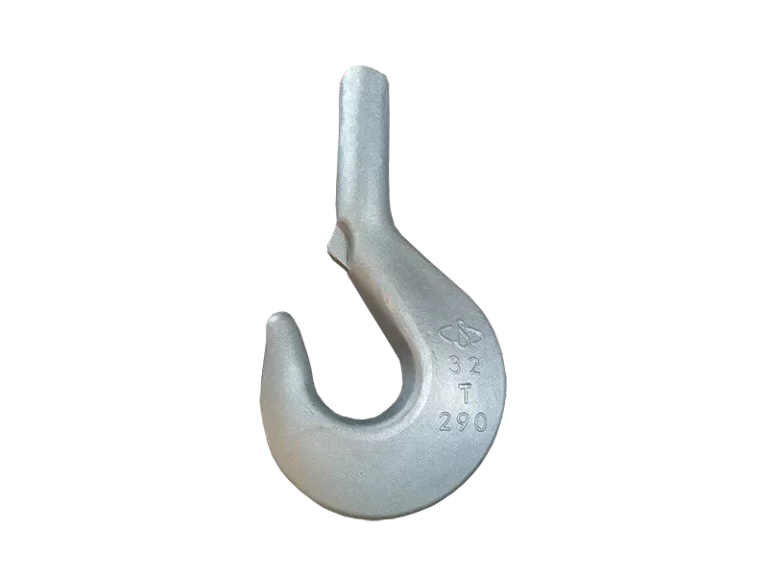
This is not about “cheap goods” in the pejorative sense. A forged hook is a forged hook: the material, the die, the heat treatment and the NDT are the same processes whether the factory is in Shanghai or Seoul. When a Chinese supplier offers the same grade of alloy steel, the same DIN/GB geometry, and the same certification — at a landed price 30–50% below a domestic or Japanese alternative — the Korean procurement manager is not buying a risk; they are buying the same part for less.
3. Scale and industrial clusters that no neighbour can match
China’s lifting-hardware industry is organized into dense regional clusters that are unmatched anywhere in the region:
- Henan (Changyuan) — the self-proclaimed “crane capital” of China, home to a vast ecosystem of crane and hook-block manufacturers;
- Shandong (Qingdao, Jimo) — a major cluster for rigging hardware, hooks, shackles and marine fittings, located right on the coast facing Korea;
- Shanxi (Dingxiang) — “China’s forging hometown”, a centre for heavy forgings such as wheels, sheaves and hooks, whose products are exported to dozens of countries.
Within these clusters, a buyer can compare suppliers, source raw alloy steel, order dies, forge, heat-treat, machine, test and pack — often within a single county. This vertical integration collapses both cost and lead time. One Shanxi forging company, for example, reports exports to more than 90 countries including South Korea; a Shandong firm supplies lifting products to more than ten countries across Asia and the Americas; and leading hook manufacturers routinely ship hook blocks to 60–100+ countries. The sheer density of capable suppliers means Korean buyers never depend on a single source — a crucial advantage for a safety-critical component.
4. Mature quality systems and international standards
The old objection to Chinese sourcing — “no certification” — has largely evaporated. Today’s export-oriented hook makers build to the same standards Korean engineers already know:
- DIN 15400 / 15401 / 15402 (German hook series and strength classes);
- GB/T 10051.1 (the Chinese lifting-hook standard, whose material and strength-class system maps directly onto the DIN grades);
- ISO 17440 for hook design, plus CE marking, ISO 9001, and third-party inspection.
Large Chinese manufacturers hold full-series CE certification and export to Europe, North America and Japan — proof that their process discipline is on par with any global supplier. The result is that a Korean customer can specify “DIN 15401, class T, alloy steel 34CrMo4”, receive exactly that, and have it verified by SGS or TÜV-style third-party inspection before shipment. Certification, in other words, is no longer a differentiator against Chinese suppliers — it is the entry ticket, and Chinese factories have it in abundance.
5. Geography: a short sea crossing and short lead times
Korea is China’s nearest industrialized neighbour. The sea route from Qingdao, Tianjin or Shanghai to Incheon, Busan or Ulsan takes days, not weeks. For a Korean buyer this means:
- Short, predictable lead times — an order can be forged, heat-treated, inspected and shipped within weeks;
- Low freight and easy returns/rework — proximity makes quality disputes cheap to resolve;
- Fast response to urgent demand — when a hook is needed for a critical shutdown, a Chinese supplier can turn an order around faster than any distant European or American forge.
The China–Korea Free Trade Agreement further eases the flow of industrial goods between the two countries, keeping tariffs and customs friction low for precisely the kind of standardized industrial input a forged hook represents.
6. Customization and OEM capability
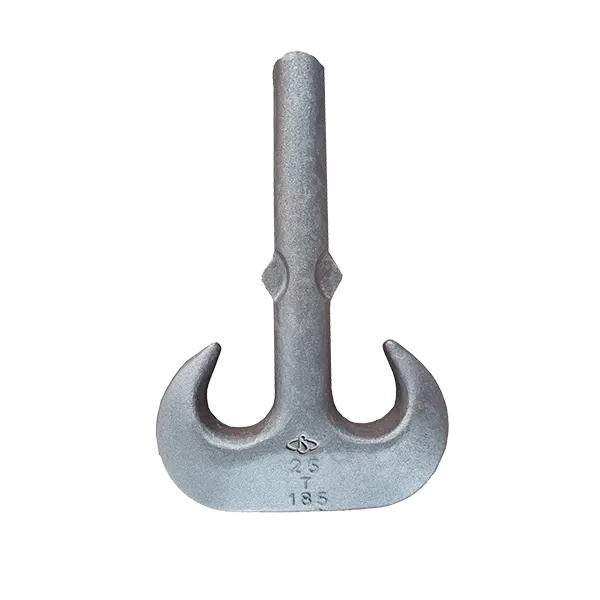
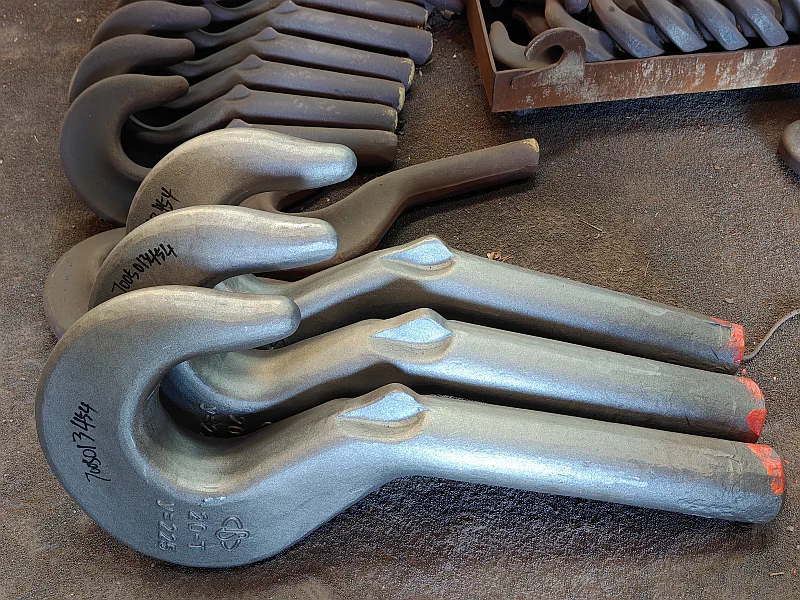
Korean buyers do not only import standard hooks. The country’s shipyards and industrial plants regularly need non-standard, application-specific lifting hardware — long-shank hooks, high-capacity ramshorn hooks, offshore and shipyard-specific designs. Chinese manufacturers have built their export business on exactly this flexibility: they routinely produce to customer drawings, in OEM/ODM arrangements, with custom hook numbers, strengths and finishes. One prominent Chinese crane maker, for instance, has delivered customized shipyard hooks for a naval project in South Korea, and another supplies forged sheaves and hooks tailored for Korean and Japanese clients. For a buyer who needs a tailored part without the lead time and cost of a European special order, Chinese suppliers are often the only economically sensible option.
7. A balanced view: what Korean buyers still keep at home
It would be misleading to claim that Korea imports everything. Korean manufacturers do produce hooks — one notable Korean supplier builds forged hook blocks in grades such as DG20Mn and DG34CrMo with full NDT — and Korean buyers often keep high-end, safety-critical, or custom-engineered hooks with domestic suppliers, especially where liability, urgent delivery or proprietary design matters more than price. But for the large, standardized, replacement-volume portion of the market — hooks that must simply meet DIN/GB/ISO requirements at the best landed cost — the economic logic points consistently toward China.
8. Conclusion
South Korean customers prefer importing forged crane hooks from China for a simple, rational set of reasons: aggressive cost competitiveness, unmatched industrial scale, full certification to the international standards they already use, short sea logistics, and the ability to customize at speed. China has spent two decades industrializing its forging clusters and proving its quality to the world’s most demanding markets — Europe, North America and Japan among them. For a Korean buyer replacing safety-critical lifting hardware on a regular cycle, choosing a certified Chinese forged hook is not a compromise. It is the optimal answer to a procurement equation that weighs price, quality, lead time and trust — and, on the evidence of the trade flows, it is an answer Korean industry has reached.