What Is a Crane Hook Block?
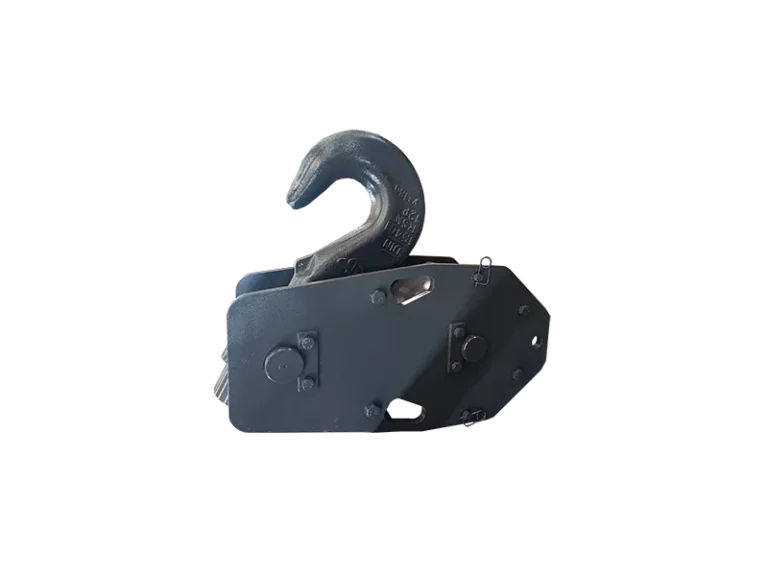
A crane hook block is the load-bearing assembly that connects the hoist rope to the hook — and ultimately to the load being lifted. It is far more than a simple hook: it is a carefully engineered unit that combines the hook itself with sheaves (pulleys), side plates, a crosshead, a thrust bearing and a safety latch, all working together to provide mechanical advantage, guide the wire rope and carry the load safely.
Choosing the right hook block is one of the most important decisions in any lifting application. The wrong choice can reduce efficiency, increase headroom loss, or — far worse — create a safety risk. This guide breaks down the most common types of hook blocks, their key features and the applications they suit best.
Core Components of a Hook Block
Before looking at types, it helps to understand what every hook block contains:
表格
| Component | Function |
|---|---|
| Hook | Forged single or ramshorn (double) hook that carries the load directly |
| Sheaves (pulleys) | Grooved wheels that guide the wire rope and provide mechanical advantage |
| Side plates (yoke plates) | Structural housing that encloses the sheaves and transmits load to the hook |
| Crosshead / hook beam | Load-bearing bar connecting the hook to the side plates |
| Thrust bearing | Allows the hook to rotate 360° smoothly under load |
| Hook nut | Secures the hook to the crosshead (per DIN 15413) |
| Safety latch | Prevents slings or chains from accidentally slipping out of the hook throat |
| Sheave bearings | Low-friction roller or ball bearings for smooth rope travel |
Classification by Number of Sheaves
1. Single-Sheave Hook Block
The simplest and most economical type, featuring one sheave and one hook. The rope runs over the single pulley directly to the winch drum.
Applications: Light loads, small electric chain hoists, jib cranes, monorail systems and any operation where minimal headroom loss is critical.
Advantages: Compact, lightweight, cost-effective, easy to maintain.
Limitation: No mechanical advantage — capacity is limited by the single line pull.
2. Multi-Sheave Hook Block
The workhorse of the lifting industry. Multi-sheave blocks feature 2, 4, 6 or even 8 sheaves, allowing the rope to be reeved multiple times between the block and the boom head. Each additional part of line multiplies the mechanical advantage.
Applications: Mobile cranes, crawler cranes, overhead cranes, port cranes and any heavy-lift operation from 20 tonnes to over 1,000 tonnes.
Advantages: Dramatically increases lifting capacity without increasing rope tension, reduces rope speed for better load control.
Consideration: More sheaves mean more headroom loss and slightly higher friction losses — a trade-off engineers must balance.
Classification by Hook Configuration
3. Single Hook Block
The most common configuration for general-purpose lifting, using one forged single hook (typically per DIN 15401 or ASME B30.10).
Applications: Standard overhead cranes, gantry cranes, electric hoists, general workshop lifting from 0.5 to 80 tonnes.
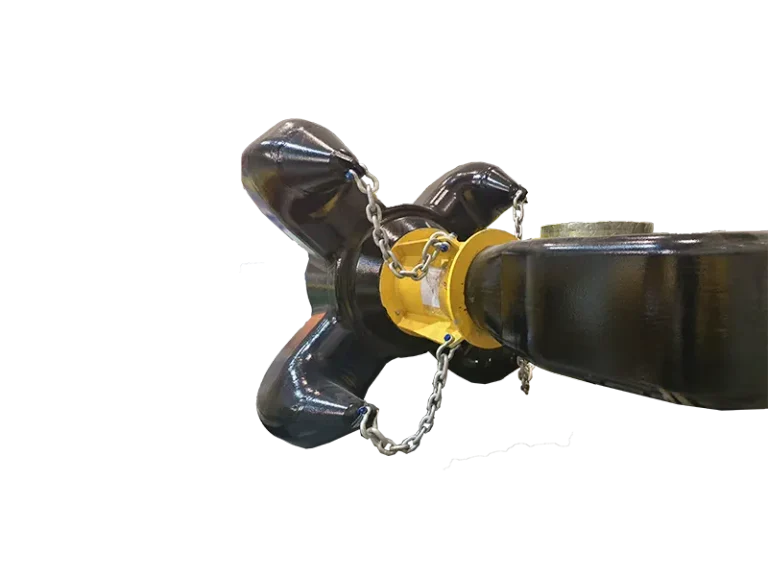
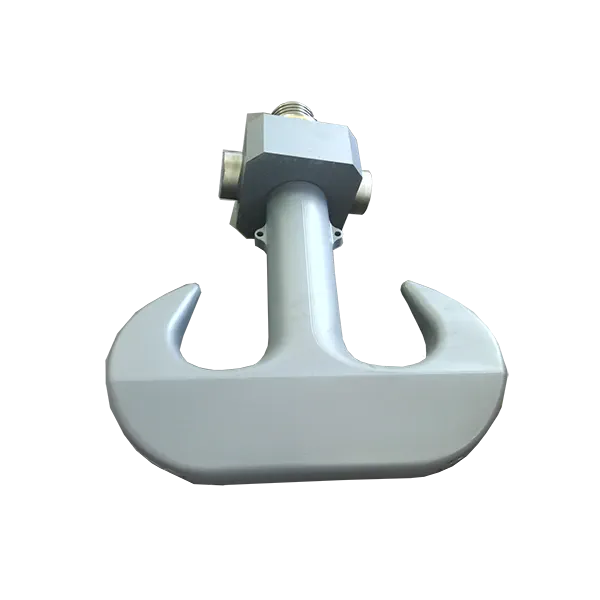
4. Ramshorn (Double) Hook Block
Named for its twin, symmetrical hook horns, the ramshorn hook features two opposing load-bearing points with a single central shank. This design balances the load evenly across two points, which is especially valuable for wide, long or flexible loads.
Applications: Steel ladle handling, heavy machinery assembly, transformer lifting, pressure vessel handling and long-load operations in metallurgy and heavy industry (typically 50–500 tonnes).
Advantages: Better load distribution, prevents sling shifting, stable handling of long loads.
Classification by Rotation
5. Fixed Hook Block
The hook is rigidly fixed relative to the block frame. Simple and rugged, with no moving parts in the hook suspension.
Applications: Where load orientation does not need to change during lifting.
6. Swivel / Rotating Hook Block
Equipped with a thrust bearing between the hook and the crosshead, allowing the hook to rotate 360° under full load. Some designs also add an anti-spin device to prevent unwanted rotation.
Applications: Precision placement work, assembly operations, container handling and any task where the load must be rotated or aligned during the lift.
Classification by Construction
7. Forged Hook Block
Manufactured from a single solid forging (or forged main components), offering the highest strength-to-weight ratio and the cleanest grain structure.
Applications: General manufacturing, factory cranes, and loads typically up to 80 tonnes.
8. Laminated (Plate) Hook Block
Built by riveting multiple steel plates together to form the hook and side structure. If one plate is damaged, the remaining plates still carry the load — a built-in redundancy that makes them exceptionally safe.
Applications: Large-capacity cranes, ladle cranes, steel plants and other heavy-duty applications where maximum safety is non-negotiable.
Classification by Closure
9. Open Hook Block
The hook throat remains open, with only a spring-loaded safety latch. Fast and convenient for quick hooking and unhooking.
Applications: General workshop lifting where speed matters.
10. Semi-Closed Hook Block
Offers a partial enclosure around the hook throat, adding security while retaining ease of use.
Applications: Medium to heavy construction and material-handling work.
11. Closed Hook Block
Fully encloses the hook within a protective structure, providing maximum security against accidental disengagement.
Applications: High-risk environments such as offshore lifting and critical precision operations.
Special-Purpose Hook Blocks
- Explosion-Proof Hook Blocks — Designed with non-sparking materials and sealed components for oil refineries, chemical plants and other hazardous atmospheres.
- Stainless Steel Hook Blocks — Corrosion-resistant construction for marine, food-processing and offshore environments.
- Offshore / Subsea Hook Blocks — Certified to classification-society rules (DNV, ABS, Lloyd’s Register, CCS), with enhanced NDT and special coatings for harsh saltwater service.
- Anti-Spin Hook Blocks — Fitted with anti-spin devices to keep the hook steady and prevent rope twisting during multi-part reeving.
How to Choose the Right Hook Block
表格
| Factor | What to Consider |
|---|---|
| Load capacity (WLL) | Match the block’s working load limit to the heaviest load, including safety factor |
| Number of sheaves | Determine mechanical advantage needed and acceptable headroom loss |
| Hook type | Single hook for general loads; ramshorn for wide or long loads |
| Rotation | Fixed for simple lifts; swivel for positioning and alignment |
| Environment | Standard, explosion-proof, stainless or offshore-rated as required |
| Standards compliance | Verify against DIN 15401/15402, EN 13001-3-5, ASME B30.10, GB/T 10051 or ISO 17440 |
| Certification | EN 10204 3.1/3.2 material certificates, proof load test certificates, classification-society approval |
Standards That Govern Hook Blocks
High-quality hook blocks are manufactured and certified to international standards, including:
- DIN 15401 / 15402 — Forged single and ramshorn hooks
- DIN 15411 / 15412 / 15413 — Hook suspensions, crossheads and nuts
- EN 13001-3-5 — European design rules for forged hooks
- ASME B30.10 — North American hook safety standard
- ISO 17440 — International design and proof standard for forged steel hooks
- GB/T 10051 — Chinese forged hook standard
Every hook block delivered should carry permanent marking (capacity, material grade, serial number, standard reference) and be supplied with proof-load test and material certificates for full traceability.
Conclusion
From the humble single-sheave block on a workshop hoist to the massive multi-sheave ramshorn block lifting a 500-tonne ladle, hook blocks come in many forms — each engineered for a specific job. The key to a safe and efficient lifting operation is matching the block type to the application: consider the load, the reeving, the environment and the required certification, and always source from manufacturers who comply with recognized international standards.
Need help selecting the right hook block for your crane? Contact our engineering team with your load capacity, crane type and working environment — we’ll recommend the perfect configuration.