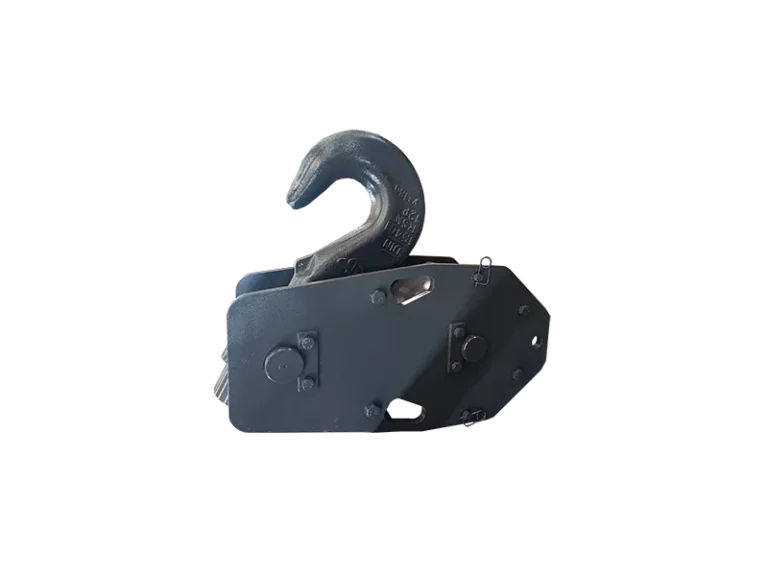
What Is a Quad Hook?
A Quad Hook (also called a four-prong hook, four-claw hook, or quadruple hook) is a heavy-duty, integrally forged lifting hook featuring four symmetrically arranged independent horns (prongs) that provide four balanced load-bearing points. Critically, it is not four separate hooks stacked together — it is a single one-piece forging, which is what distinguishes it from a multi-hook assembly.
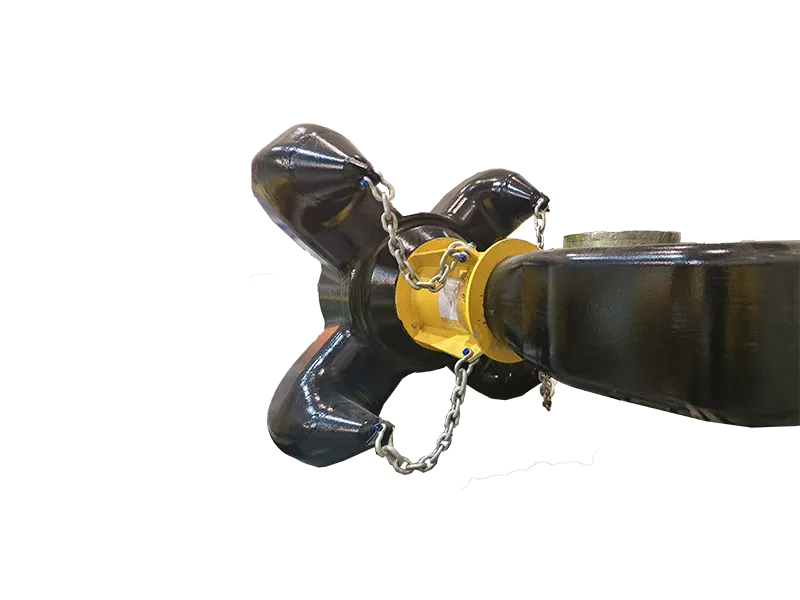
Quad hooks are engineered specifically for extra-large tonnage loads requiring multi-point balanced lifting, where single or double hooks cannot provide sufficient capacity or four-point stability.
Key Characteristics
- Four-point balanced loading — evenly distributes load gravity across four symmetric horns, preventing cargo slippage and tipping caused by uneven stress distribution
- Integral one-piece forging — maximum structural strength and reliability under extreme loads; no welded or bolted joints in the load path
- High-strength alloy steel — typically manufactured in the highest strength grades (V / W), with a minimum safety factor of 4:1
- Rounded-arc horn tips — designed to minimize surface damage and indentation to the cargo
- Compact, robust structure — strong mechanical properties, remaining stable and reliable even under extreme heavy loads
- Capacity range — typically from 160 t up to 4,000 t, with equal load shared on all four prongs
- Standard reference — DIN 15402-C (quad hook configuration)
Typical Applications
- Steel & metallurgy industry — lifting steel ladles, ingots, large slabs, continuous-casting billets and rolling-mill equipment; a core lifting device for high-capacity steel-plant cranes
- Heavy machinery assembly — generator stators, turbine rotors, pressure vessels, transformers and large gearboxes
- Large structural-component lifting — bridge steel box girders, offshore engineering modules, TBM (tunnel-boring machine) components and other wide, long loads requiring four-point stability
- Construction — large precast concrete elements and structural steel beams/columns lifted at four points
- Floating cranes & offshore — heavy-duty rigging on floating cranes, where four-jaw hooks are widely used
- Ports & shipbuilding — large hull sections, marine engines and heavy port equipment
Why Choose a Quad Hook Over a Single or Double Hook?
- The load exceeds the safe capacity range of a double hook (typically above 200–500 t)
- The load has a large length-to-width ratio or a wide center-of-gravity distribution, requiring four load points to remain level and stable
- Single- or double-point lifting would cause the load to tilt, slings to slip, or excessive local stress
Technical Specifications
| Parameter | Specification |
|---|---|
| Working Load Limit (WLL) | 160 t – 4,000 t (equal load on four prongs) |
| Material | High-strength alloy steel (super alloy) |
| Strength grade | V / W |
| Safety factor | Min. 4:1 (with the highest material grade) |
| Standard | DIN 15402-C (quad hook configuration) |
| Construction | Integral one-piece forging + heat treatment |
| Certification | EN 10204 3.1 (3.2 available on request) |
Positioning vs. Other Hook Types
| Hook Type | Typical Capacity | Load Points | Suitable Load |
|---|---|---|---|
| Single Hook | 0.5 – 80 t | 1 point | General, conventional loads |
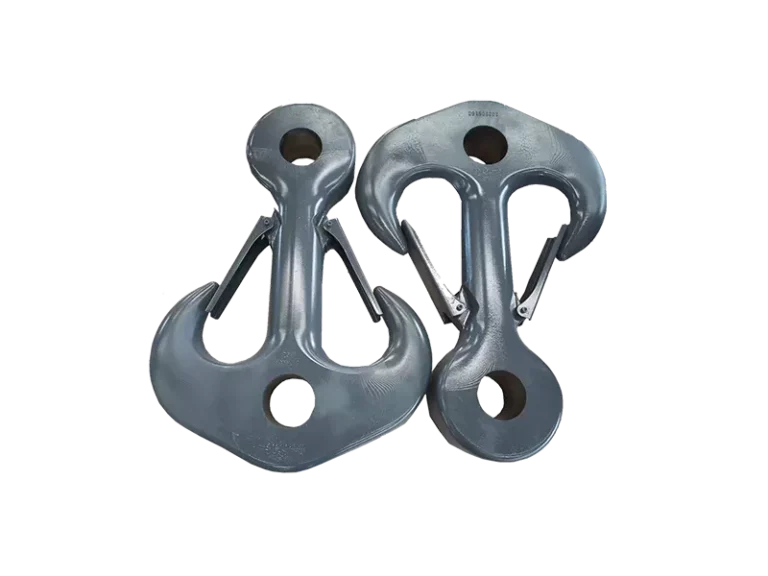
| Ramshorn (Double) Hook | 50 – 500 t | 2 points | Long loads, medium-heavy duty |
| Quad Hook | 160 – 4,000 t | 4 points | Extra-heavy, wide-body, four-point balanced loads |
Best Suited For
Quad hooks are the ideal choice for extra-heavy, wide-body loads where single or double hooks cannot provide sufficient lifting capacity or the four-point stability required to keep the load level and secure. They are the go-to solution for steel mills, heavy machinery assembly, large structural lifting, floating cranes and shipbuilding operations involving loads from 160 tonnes up to several thousand tonnes.