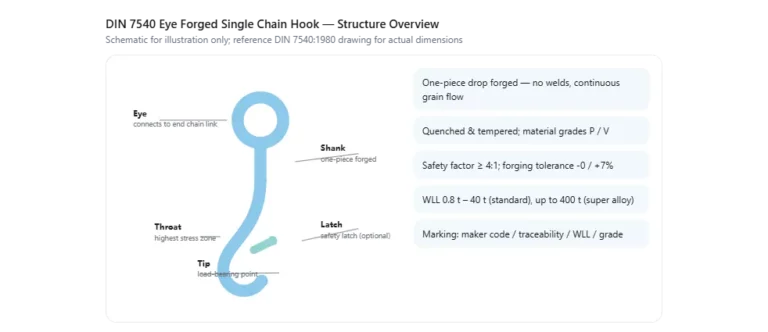
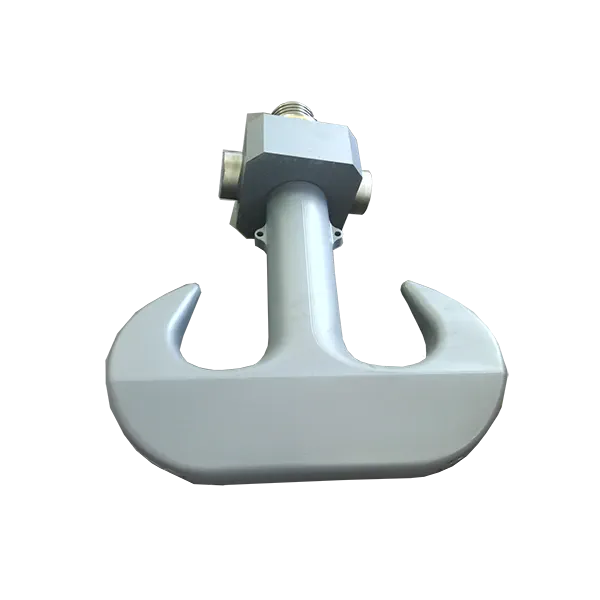
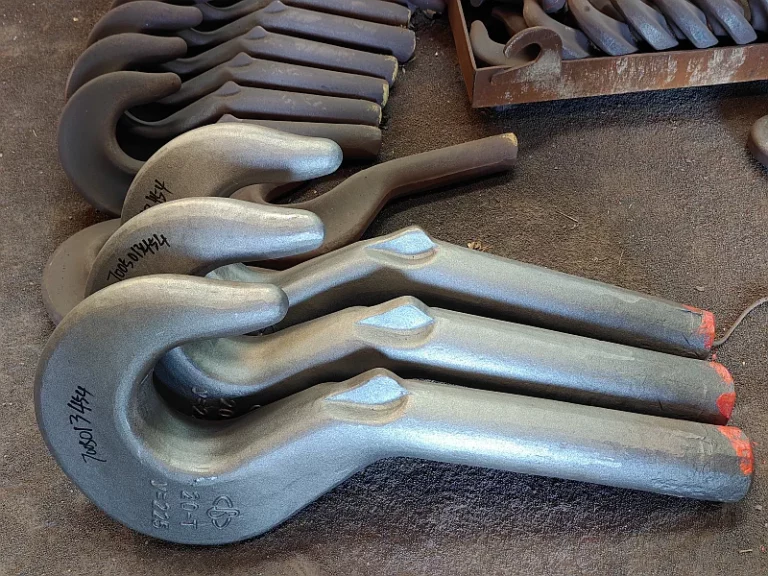
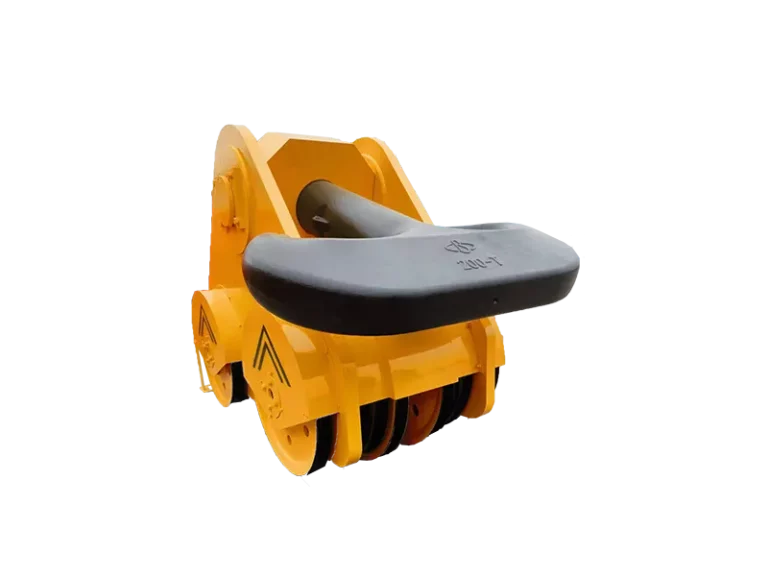
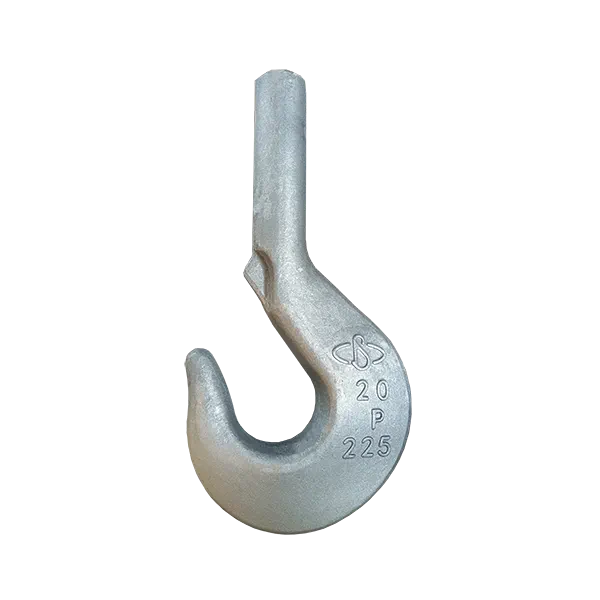
DIN 15401 (single forged hook) and DIN 15402 (double ramshorn hook) are originally German industrial standards. However, they have long transcended regional specifications and become the de facto global universal standard for lifting hooks, widely adopted in international trade, crane manufacturing and overseas engineering projects.
Unlike ASME, ISO or various national standards that lack unified dimensional constraints or complete supporting systems, DIN 15401/15402 dominates the global lifting industry for five decisive advantages:
1. Fully Unified & Interchangeable Dimensional System
DIN provides complete, fixed dimensional specifications for both hook blanks and finished products, covering all core parameters including shank size, throat opening, curvature radius, body thickness and mounting interface.
This standardized sizing achieves 100% cross-brand and cross-manufacturer interchangeability. All DIN-standard hooks can perfectly match global standard crane blocks, safety latches and pulley systems. It greatly simplifies international procurement, equipment assembly and after-sales replacement — a key advantage that ASME and other regional standards cannot provide.
2. Complete Hierarchical Material & Performance Classification
DIN establishes a scientific five-level strength grading system: P / S / T / V / W, covering light-duty general lifting, medium-frequency industrial operation, heavy-duty mining and ultra-high-strength metallurgical scenarios.
It enforces strict control over chemical composition, grain structure, low-temperature impact toughness and fatigue resistance. The standardized graded performance system unifies quality judgment worldwide, ensuring stable and consistent mechanical properties for hooks of different load levels across global manufacturers.
3. Complete Compatibility with EN Global Industrial System
DIN hook standards are highly compatible with the full set of European industrial norms, forming a closed-loop authoritative system:
- Design specification: Matches EN 13001 crane limit-state design
- Inspection standard: Complies with EN 10228 MT/UT non-destructive testing
- Certification support: Supports globally recognized EN 10204 3.1/3.2 official certification
- Safety compliance: Meets EU CE machinery directive requirements
No other hook standard in the world has such a complete and internationally recognized supporting system, making DIN hooks fully compliant for global export and third-party inspection.
4. Mature Global Industrial Ecosystem & Market Dominance
European crane and lifting equipment manufacturers have led the global industry for decades with widespread adoption of DIN standards. This has formed a huge global installed base, mature supply chain and unified industrial cognition.
At present, most global lifting accessory factories, engineering contractors and spare part suppliers uniformly adopt DIN 15401/15402 dimensions for production and procurement. The formed universal industrial ecosystem cannot be replaced by any new or regional standard.
5. Rigorous Safety Design & Wide Project Adaptability
Different from traditional fixed safety factor design adopted by many national standards, DIN combines limit-state design philosophy and dynamically adjusts safety redundancy according to crane working classes (M1–M8).
With stricter micro-defect inspection, fatigue resistance verification and deformation discard criteria, DIN standards meet the high safety requirements of metallurgy, ports, offshore engineering, petrochemical and other high-risk projects. It is universally recognized and accepted by Europe, America, the Middle East, Southeast Asia and African markets.
Conclusion
DIN 15401/15402 is no longer a simple German local standard. By virtue of unified dimensions, graded performance, complete certification system and universal compatibility, it has become the most authoritative, stable and widely accepted global public specification for forged lifting hooks, serving as the preferred standard for mainstream international lifting trade and engineering projects.