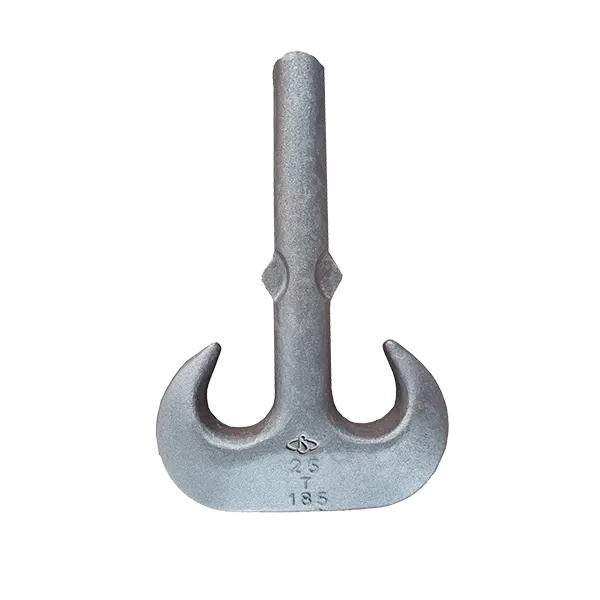
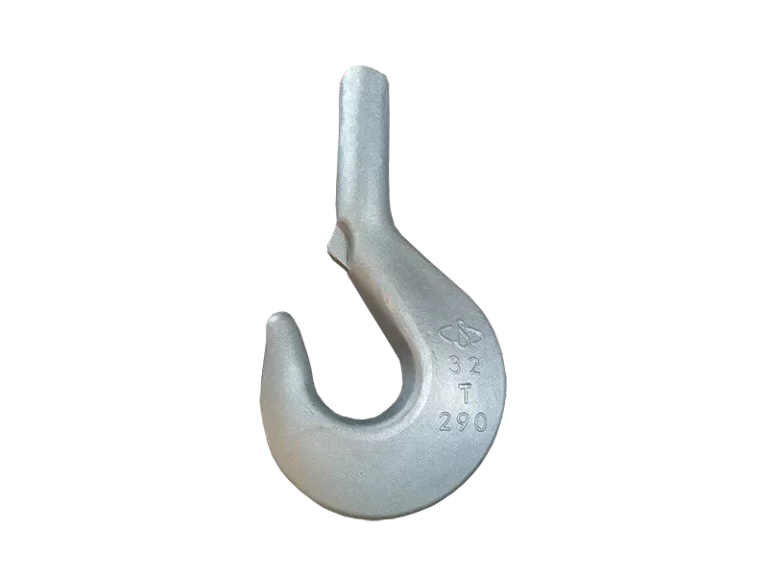
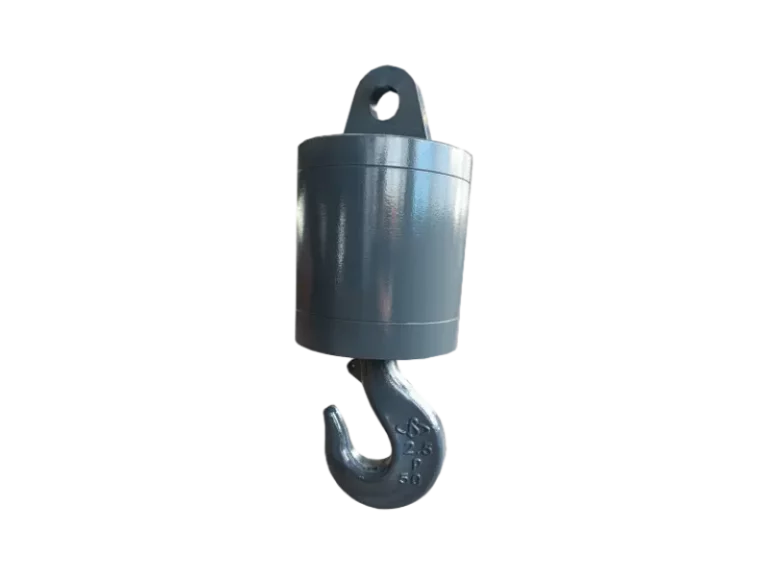
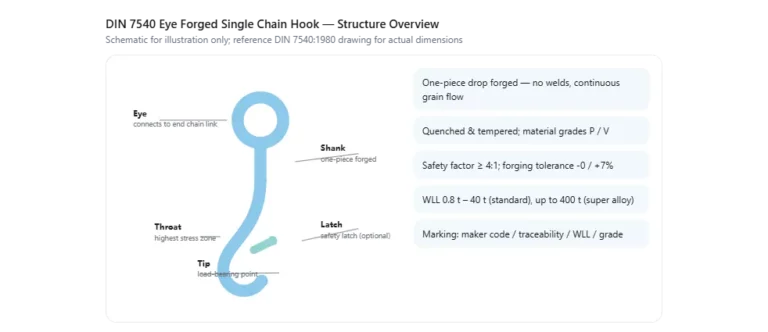
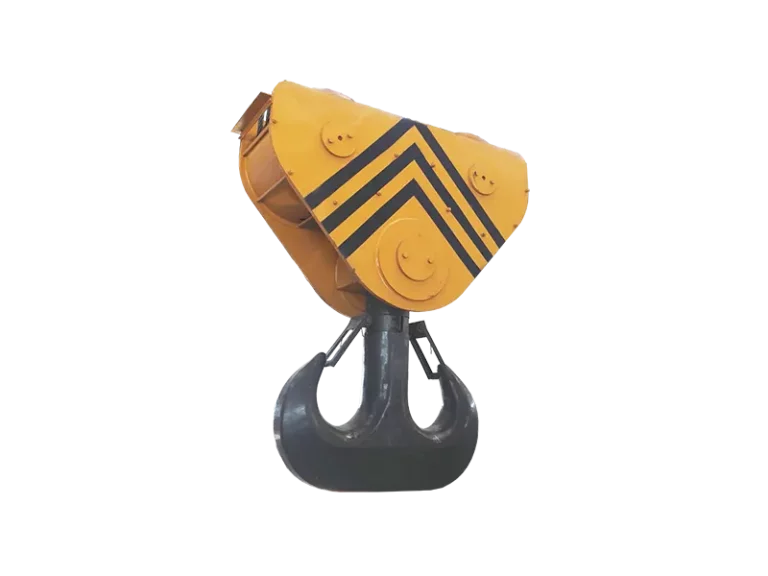
In a previous post we looked at DIN 15402 Part 1, which covers ramshorn hooks in the unmachined (blank) state. But a forged blank can’t be fitted to a crane on its own — it still needs a machined shank, a thread, and a matching nut. That is exactly where DIN 15402 Part 2 comes in.
This article summarizes DIN 15402 Part 2 — the companion standard for finished ramshorn hooks with threaded shank.
1. What Is DIN 15402 Part 2?
DIN 15402-2 (published 1983-09) is titled:
“Lifting hooks for lifting appliances; Ramshorn hooks; Finished parts with threaded shank”
(German: “Lasthaken für Hebezeuge; Doppelhaken; Fertigteile mit Gewindeschaft”)
While Part 1 defines the hook in its unmachined (as-forged) state, Part 2 defines the same hooks in their finished state — that is, after the shank has been machined and provided with a thread so the hook can be mounted into a hook block or crosshead.
In short:
| Part | Title | Condition |
|---|---|---|
| DIN 15402-1 (1982) | Ramshorn hooks — unmachined parts | Forged blank |
| DIN 15402-2 (1983) | Ramshorn hooks — finished parts with threaded shank | Machined, threaded |
2. From Blank to Finished Hook
The two parts of the standard map neatly onto the manufacturing workflow of a ramshorn hook:
- Forging — the hook is forged to the blank geometry specified in Part 1 (with deliberate oversize tolerances to leave machining allowance).
- Machining the shank — the shank is turned down to its finished diameter and threaded.
- Finished hook — the result conforms to Part 2, ready for assembly into a hook block.
This is why Part 1’s tolerances were mostly “oversize only” (+X/0): the extra material is removed during the machining step that turns the Part 1 blank into a Part 2 finished component.
3. Why the Threaded Shank Matters
The threaded shank is the hook’s mounting interface. It is what allows the hook to be secured to the rest of the lifting gear:
- The shank passes through the crosshead (cross piece) of the hook block.
- A lifting hook nut is screwed onto the thread to retain the hook.
- A thrust bearing is typically fitted between the nut and the crosshead so the hook can rotate freely under load.
This assembly is standardized by companion DIN standards that are worth knowing alongside DIN 15402-2:
| Standard | What it covers |
|---|---|
| DIN 15402-2 | Finished ramshorn hooks with threaded shank |
| DIN 15412-2 | Bottom blocks for lifting appliances — cross pieces (finished parts) |
| DIN 15413 | Bottom blocks for lifting appliances — lifting hook nuts |
Knowing all three together gives you the complete picture of a ramshorn hook assembly.
4. What Part 2 Specifies
Although the full clause text is only available in the official document (5 pages), Part 2 builds on Part 1 and covers the finished hook’s:
- Threaded shank dimensions and thread specification — diameter, thread form, and tolerances
- Finished hook geometry — the machining of the shank relative to the forged body
- Hook numbering — continuing the same No. 05 to No. 250 system established in Part 1
- Material and strength classes — tied to the DIN 15400 system (classes M, P, S, T, V)
- Reference to Part 1 — the blank geometry from which the finished hook is produced
In practice, the hook number remains the key reference identifier across both parts: a “No. 25 ramshorn hook” means the same size class whether you are talking about its blank (Part 1) or its finished, threaded form (Part 2).
5. Relationship to the Broader DIN 15400 Family
DIN 15402 Part 2 does not exist in isolation. It is one piece of a coordinated set of German lifting-hook standards:
- DIN 15400 — general requirements and strength classes for lifting hooks
- DIN 15401 — single hooks (both unmachined and finished parts)
- DIN 15402 — ramshorn (double) hooks
- Part 1 — unmachined parts
- Part 2 — finished parts with threaded shank
- DIN 15411 / 15412 — bottom blocks and cross pieces
- DIN 15413 — lifting hook nuts
This structure ensures that every component of a hook assembly — hook, crosshead, nut, and bearing — is specified in a mutually compatible way.
6. Applications
Finished ramshorn hooks per DIN 15402-2 are the same heavy-duty double hooks described in Part 1, now in a ready-to-install condition. They are found in:
- Bridge and gantry cranes
- Port, shipyard, and steel-mill cranes
- Metallurgical and foundry lifting
- Power-generation and nuclear installations
- Heavy industrial and construction lifting
Wherever loads are large enough to require a double-point hook for stability and load distribution, the Part 2 finished hook is what actually gets assembled into the crane.
7. Summary
- DIN 15402 Part 2 defines finished ramshorn hooks with a threaded shank — the machined, ready-to-mount form of the hook.
- It is the natural follow-up to Part 1, which covers the same hooks as unmachined (forged) blanks.
- The threaded shank is the mounting interface, used together with a hook nut (DIN 15413) and a crosshead (DIN 15412-2).
- The hook numbering system (No. 05–250) and strength classes (M–V) remain consistent across the DIN 15402 series.
- Together, DIN 15402-1 and DIN 15402-2 give you a complete specification for a ramshorn hook — from forging blank to finished, installable component.
For authoritative dimensions and thread specifications, always work from the official DIN 15402-2:1983 document — this article is an educational summary, not a substitute for the standard.
Disclaimer: This article is an educational summary based on publicly available information about DIN 15402. For design, procurement, or certification purposes, always consult the official standard text and applicable national regulations.