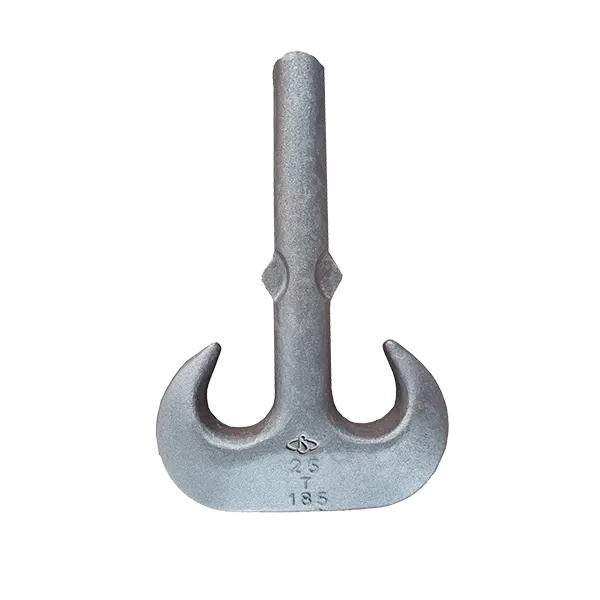
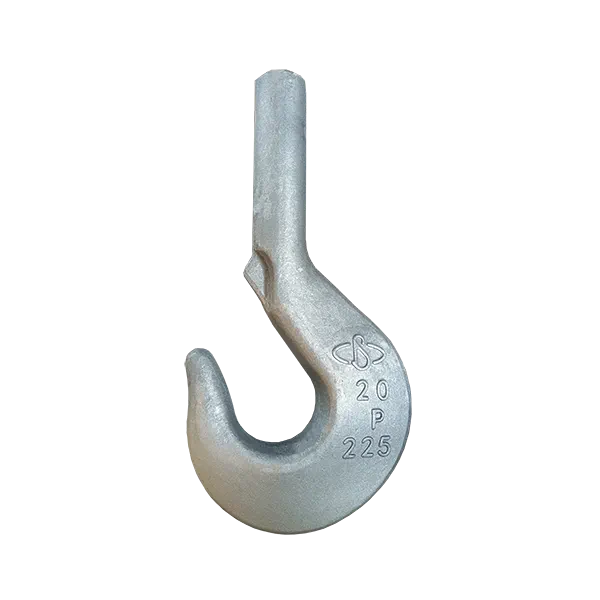
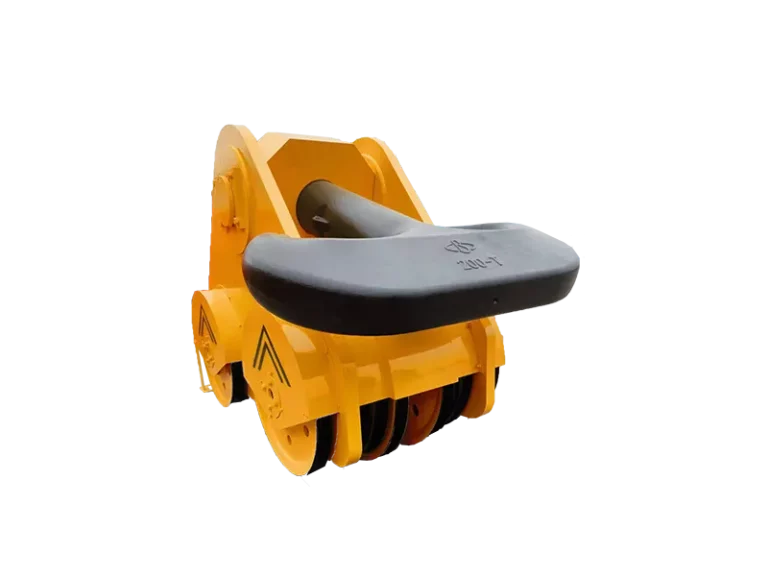
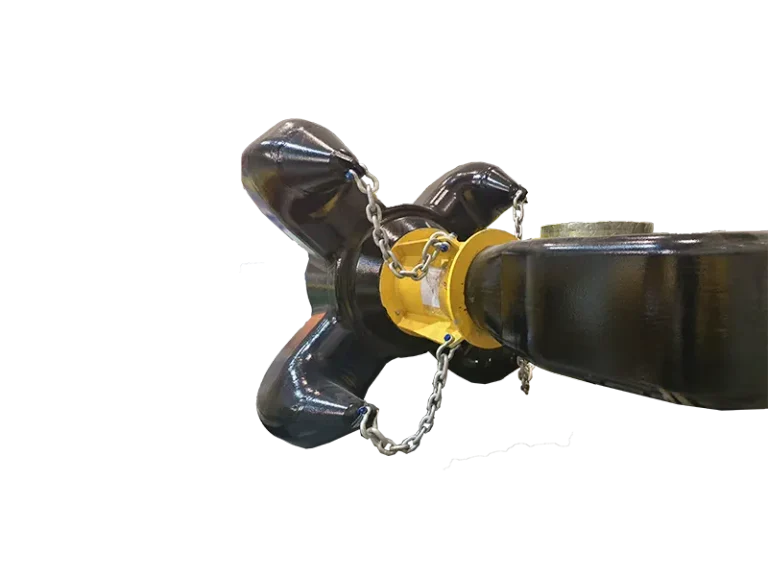
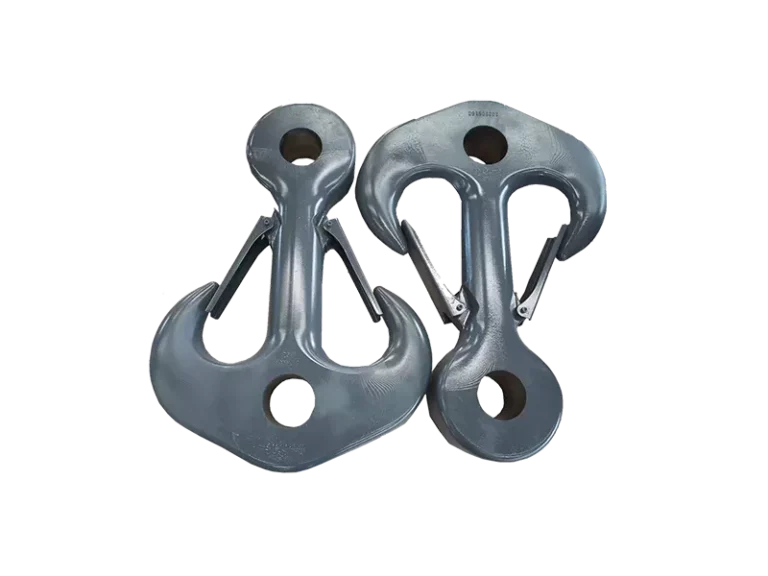
In the world of lifting and rigging, the most critical components are often the smallest. The Eye Forged Single Chain Hook — a forged hook with an integral eye — is one of the most important end fittings on chain slings. It must withstand loads of tens of tonnes while mating precisely with chain links and shackles. This article breaks down its definition, features, applications, and certification requirements under the DIN 7540 standard.
1. Product Definition
An Eye Forged Single Chain Hook is the terminal connecting element of a chain sling: one end features an integral eye (ring) that threads directly onto the end link of a lifting chain, while the hook body carries and secures the load. “Single” refers to its use on single-leg chain slings — one chain, one hook.
It is defined by DIN 7540:1980, titled Eye hooks, grade 5, published by the German Institute for Standardization (DIN) in October 1980, superseding DIN 689:1975. The four-page standard covers dimensions, material and chemical composition, heat treatment, mechanical properties, load capacity, surface quality, defect control, marking, testing, and safety requirements — a dual dimensional-and-grade specification. International equivalents include UNI EN 13411-1 (Italy), NF EN 13411-1 (France), and BS EN 13411-1 (UK).
Each keyword in the name reflects a hard design requirement:
- Eye: the top of the hook is forged with an integral ring for direct articulation with the chain link — simpler than a clevis connection and free to rotate within a working angle;
- Forged: one-piece drop forging produces continuous grain flow with no welds and no casting defects, giving far higher strength and fatigue life than cast alternatives;
- Single Chain: the hook is rated for single-leg chain slings, with hook grade matched to chain grade.
2. Key Features
Based on the standard’s requirements and the practice of European manufacturers, typical features include:
- One-piece forged & heat treated: forged from carbon steel, alloy steel, or super-alloy, then quenched and tempered for uniform strength and toughness; stainless steel available on request;
- Safety factor ≥ 4:1: minimum 4:1 ratio of breaking load to working load limit (WLL) at the highest material grade;
- Clear material grades (P / V): mechanical properties are classified by grade, with V being the common high-grade option aligned with the chain strength system;
- Wide load range: the standard series covers WLL from 0.8 t to 40 t; extended series reach up to 400 t with super-alloy materials;
- Forging tolerance -0 / +7%: dimensions only deviate upward, never “shrink”;
- Optional safety latch: prevents the sling or load from slipping out of the hook mouth;
- Full marking: every hook is permanently stamped with the maker’s code, traceability code, WLL, and grade number for life-cycle traceability.
The illustration below shows the hook structure and its core process features (schematic, not an official drawing):
3. Dimensions and Specification Range
Table 1: DIN 7540:1980 Standard Series (No. 19–36)
The standard defines 14 sizes from No. 19 to No. 36, with WLL covering 800 kg to 40 t. Each size carries a full set of key dimensions (hook mouth width b, eye bore d, shank diameter, hook height h, corner radii r, etc.) to ensure interchangeability between makers.
表格
| No. | WLL (kg) | Approx. weight (kg) | No. | WLL (kg) | Approx. weight (kg) |
|---|---|---|---|---|---|
| 19 | 800 | 0.15 | 28 | 6,300 | 3.9 |
| 21 | 1,250 | 0.35 | 29 | 8,000 | 5.7 |
| 23 | 2,000 | 0.8 | 30 | 10,000 | 8.0 |
| 25 | 3,200 | 1.4 | 31 | 12,500 | 11.5 |
| 27 | 5,000 | 2.6 | 32 | 16,000 | 16.0 |
| 33 | 20,000 | 22.0 | 35 | 32,000 | 46.0 |
| 34 | 25,000 | 31.5 | 36 | 40,000 | 63.0 |
Table 2: Extended Series Based on DIN 7540 Design (No. 34–43)
As published in the catalogue of a European manufacturer, larger sizes are extended on the “DIN 7540 design” basis, with WLL rated for V-grade material and covering 40 t to 400 t.
表格
| No. | WLL (t) | Approx. weight (kg) | No. | WLL (t) | Approx. weight (kg) |
|---|---|---|---|---|---|
| 34 | 40 | 35 | 39 | 150 | 250 |
| 35 | 50 | 51 | 40 | 200 | 365 |
| 36 | 63 | 68 | 41 | 250 | 515 |
| 37 | 80 | 80 | 42 | 300 | 730 |
| 38 | 100 | 125 | 43 | 400 | 1,055 |
Note: The two tables use different numbering schemes — in Table 1, No. 34 = 25 t (standard); in Table 2, No. 34 = 40 t (extended series). Always confirm “size number + series source” when selecting. Overall dimensions (hook width b₁, eye bore d₁, shank diameter d₂, etc., in mm) and the -0/+7% forging tolerance scale up with size; full dimension drawings and smaller/special sizes are available on request.
4. Applications
This hook is most typically used as the end fitting of chain slings, paired with EN 818-series lifting chains, across a wide range of industries:
- Construction & engineering: lifting and positioning precast elements, steel structures, and formwork;
- Ports & logistics: container and heavy-equipment handling;
- Marine & offshore: ROV launch-and-recovery, platform equipment lifts — the eye connection suits quick rigging with chains and shackles, and corrosion-resistant versions are especially favored;
- Mining & energy: wind turbine erection, maintenance of mining machinery;
- Manufacturing: in-plant crane handling of large workpieces.
It can be used alone on single-leg slings for direct attachment, or combined through the eye with shackles, swivels, and intermediate links to build multi-leg sling systems for flexible lifting configurations.
5. Certification and Compliance
For products sold into the European market, “compliant with DIN 7540” is only the first step — DIN 7540 governs dimensions and grade, while safety and market access rely on the EN standard system. Key compliance points:
- CE marking (EU market): sling components fall under Machinery Directive 2006/42/EC. Forged hooks are assessed under the EN 1677 series — EN 1677-2 for grade 8 forged steel hooks with latch (eye or clevis, up to 63 t WLL), EN 1677-5 for grade 4; complete chain slings are further governed by EN 818-4 / EN 818-5.
- Material certificates: an EN 10204 3.1 inspection certificate (actual test results for the supplied batch, signed by the maker’s independent QC) is standard; upgrade to 3.2 with third-party witnessing, with ILO-3, FAT (factory acceptance test), or breaking tests available on request.
- Load testing: per EN 1677, each hook undergoes a proof load test, typically at 2.5 × WLL; breaking tests are performed on batch samples at no less than 4 × WLL, with no permanent deformation or fracture allowed.
- Non-destructive testing: 100% magnetic particle inspection (MPI) after heat treatment to detect forging cracks and surface defects.
- Marking & traceability: hooks must be permanently stamped with the manufacturer’s code, traceability code, WLL, and grade.
- Temperature range: for comparable EN 1677-2 hooks, typical service temperature is -40 °C to +200 °C; beyond this, consult the manufacturer.
6. Usage and Inspection Tips
Hooks are wear items. During use, check that: throat-section wear at the critical (danger) zone does not exceed 5% of the original dimension, the mouth opening increase does not exceed 10%, there are no cracks or plastic deformation, and the latch moves freely. Defects must never be repaired by welding — replace the hook immediately. Matching the hook grade to the chain grade, avoiding overloads and shock loads, will significantly extend service life.
Summary: The DIN 7540 eye forged single chain hook is a classic product — a 1980s dimensional standard that remains the global design baseline for chain-sling hooks, while today’s products gain market access through EN 1677 safety standards and CE marking. When sourcing, look for the DIN 7540 dimensions + EN 1677 safety + EN 10204 certificate combination for reliable lifting safety.