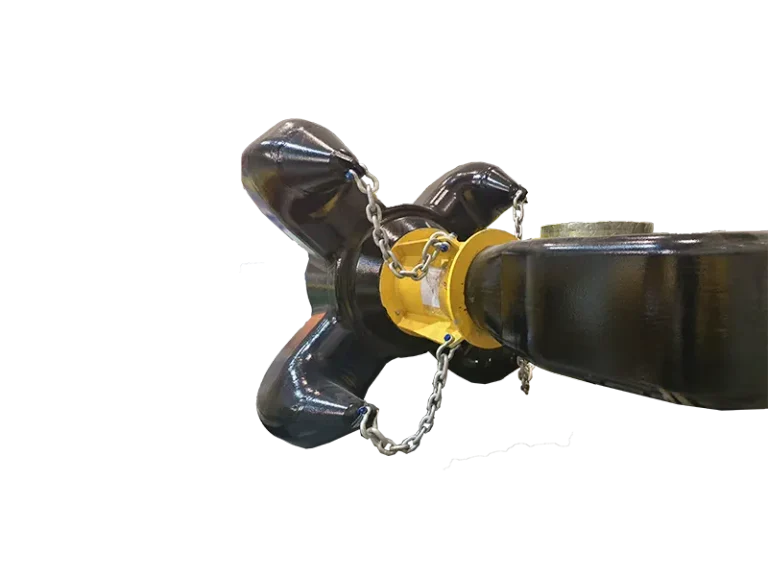
Lifting hooks and hook blocks are core load-bearing components of all crane and hoisting equipment, undertaking the critical task of connecting slings and bearing heavy working loads. As key safety parts for industrial lifting, their material quality, forging technology, heat treatment and testing standards directly determine the safety, stability and service life of the entire hoisting system. Among industrial lifting accessories, DIN-standard forged hooks and matched hook blocks are widely recognized for their high reliability, precise dimensions and excellent mechanical performance, becoming the preferred choice for European-style cranes, port machinery, metallurgical equipment and heavy-duty engineering machinery.
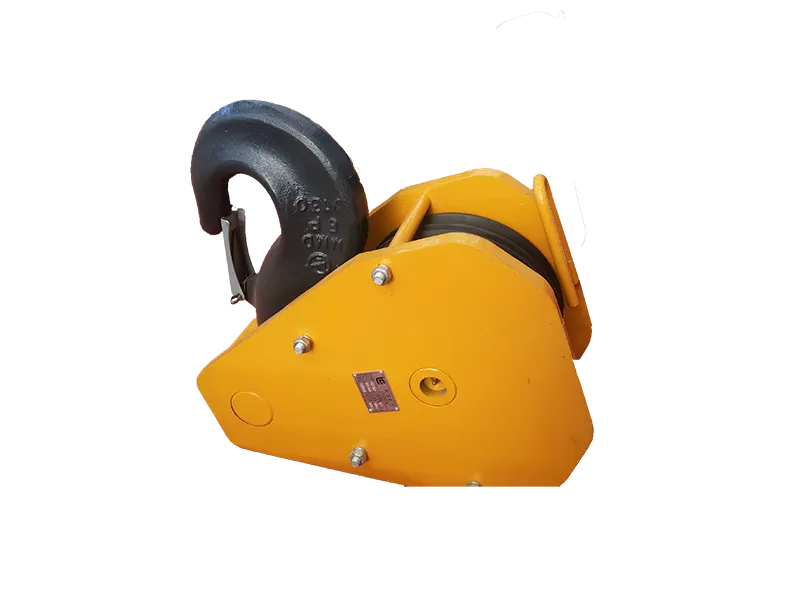
Basic Classification of Forged Lifting Hooks (DIN Standard Series)
DIN-standard lifting hooks are strictly divided into single hooks and ramshorn (double) hooks, and each type includes two complete specifications: unmachined blanks and finished machined parts, forming a standardized and systematic product system.
1. DIN 15401 Single Hook Series
DIN 15401-1 Unmachined Single Hook Blanks
DIN 15401-1 single hook unmachined parts are heat-treated forged semi-finished blanks manufactured in accordance with German industrial standards. Produced via open die forging and close die forging processes, these hook blanks complete integral forging and quenching & tempering heat treatment before delivery, with continuous and dense metal flow lines and stable internal metallurgical structure. No thread cutting, bearing surface finishing or final dimensional trimming is performed, reserving sufficient machining allowance for customized processing. They are available in two structures: with nose and without nose, serving as standard raw forgings for manufacturing DIN 15401-2 finished single hooks.
These single hook blanks are mainly used by crane manufacturers and machinery factories with independent CNC machining capabilities. They support custom modification of shank length and key dimensions according to equipment drawings, effectively shortening the overall production cycle of crane hook assemblies and meeting the personalized assembly needs of various small and medium-tonnage overhead cranes, gantry cranes and electric hoists. It is worth noting that unmachined hook blanks are semi-finished products and cannot be directly used for lifting operations.
DIN 15401-2 Finished Single Hooks
DIN 15401-2 finished single hooks are ready-to-install load-bearing components processed from DIN 15401-1 blanks. All precision machining procedures including shank thread turning, bearing surface finishing and dimensional calibration are fully completed. Each finished hook undergoes strict non-destructive testing, dimensional inspection and proof load test, and is permanently marked with strength class and working load limit (WLL) for full traceability.
With high strength, good low-temperature toughness and stable load-bearing performance, finished DIN single hooks are widely applied in light and medium heavy-duty hoisting scenarios, including single-beam overhead cranes, electric hoists, construction machinery and general industrial hoisting equipment. The standardized thread and mounting structure ensures perfect matching with standard hook blocks and crane suspension systems.
2. DIN 15402 Ramshorn (Double) Hook Series
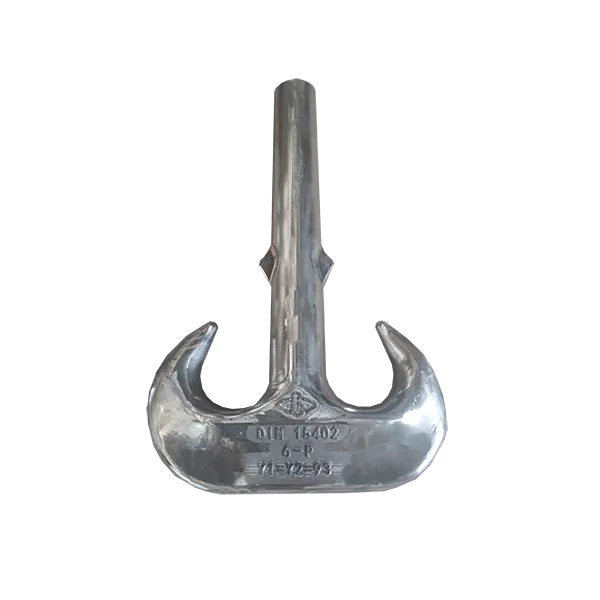
DIN 15402-1 Unmachined Ramshorn Hook Blanks
DIN 15402-1 unmachined double hook blanks are standard forged semi-finished products for heavy-duty ramshorn hooks. Adopting professional closed-die forging technology, the forgings have uniform internal structure, no internal defects such as inclusions and pores, and complete heat treatment is finished before leaving the factory to ensure qualified hardness and toughness. Similar to single hook blanks, they have no threaded shank and finished bearing surface, retaining machining allowance for secondary precision processing, and provide two structural options: with nose and without nose.
This type of hook blank is specially used for processing DIN 15402-2 finished double hooks, and is suitable for supporting the production of heavy-tonnage crane equipment. It is widely stocked and applied by professional crane supporting manufacturers to realize standardized and customized production of heavy-duty hook components.
DIN 15402-2 Finished Ramshorn Double Hooks
DIN 15402-2 finished double hooks are mature and usable hoisting components processed from 15402-1 blanks. Featuring a symmetrical double-throat structure, they realize balanced two-point load distribution, effectively avoiding sling extrusion and unbalanced force during heavy-load hoisting. All finished products pass mandatory proof load tests, visual inspection, magnetic particle testing (MT) and ultrasonic testing (UT) to eliminate surface and internal hidden cracks.
Double finished hooks are mainly used for heavy-duty hoisting scenarios above 50 tons, including large overhead cranes, port portal cranes, metallurgical casting cranes, and heavy equipment assembly machinery. The balanced stress structure makes them more suitable for large-tonnage and stable hoisting operations than single hooks.
Core Manufacturing Processes of Forged Hooks
The excellent performance of DIN standard lifting hooks benefits from scientific and standardized forging processes. The core molding procedures include four key steps, which jointly ensure the high reliability of hook products:
- Upset Forging: Axial compression is adopted to locally thicken the steel blank, increase the local cross-sectional area, and reserve sufficient metal volume for forming the hook throat and hook tip, avoiding insufficient material filling during subsequent molding.
- Bending: The pre-forged blank is bent into a standard hook curved profile, forming the basic geometric shape of the lifting hook and laying a foundation for precise die forging molding.
- Open Die Forging: Preliminary forging and shaping of the blank is carried out to refine the internal grain structure, eliminate metallurgical defects, and improve the overall compactness and toughness of the forging.
- Close Die Forging: Final precise molding is completed through matched molds to realize near-net-shape production, ensuring accurate overall dimensions, smooth surface and continuous metal flow lines of the hook.
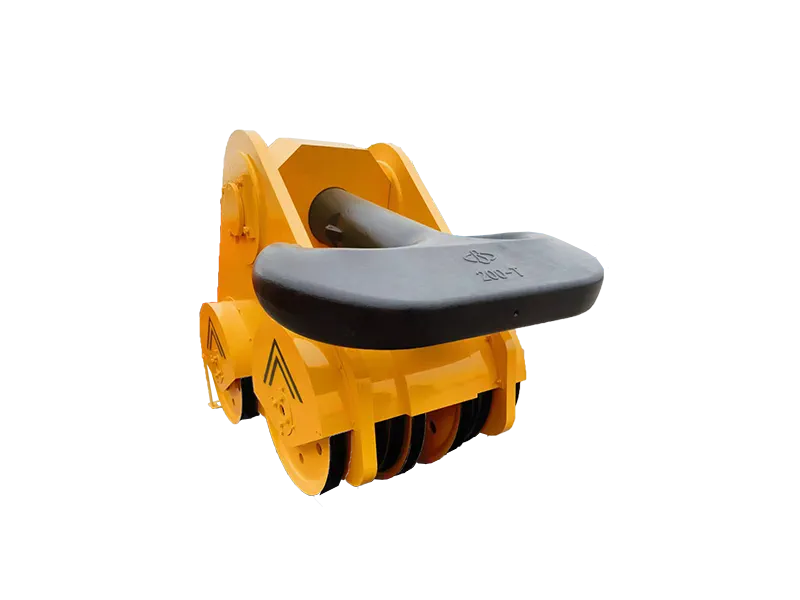
Introduction to Crane Hook Blocks
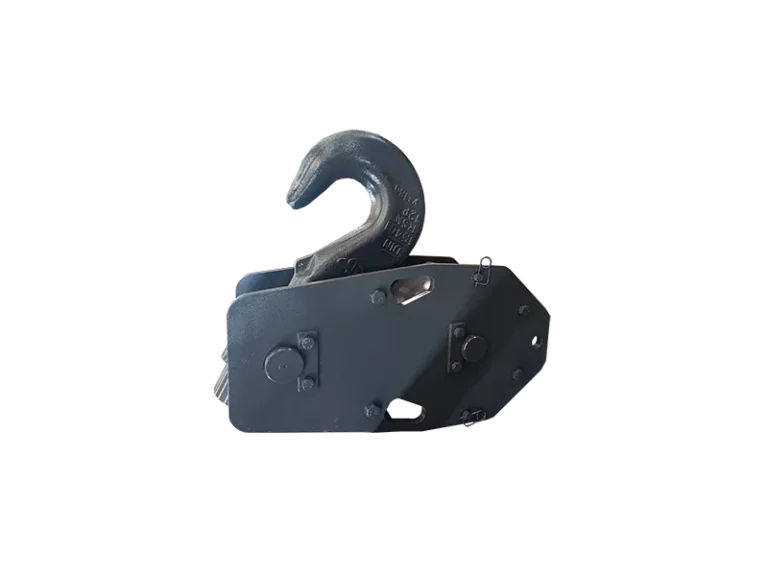
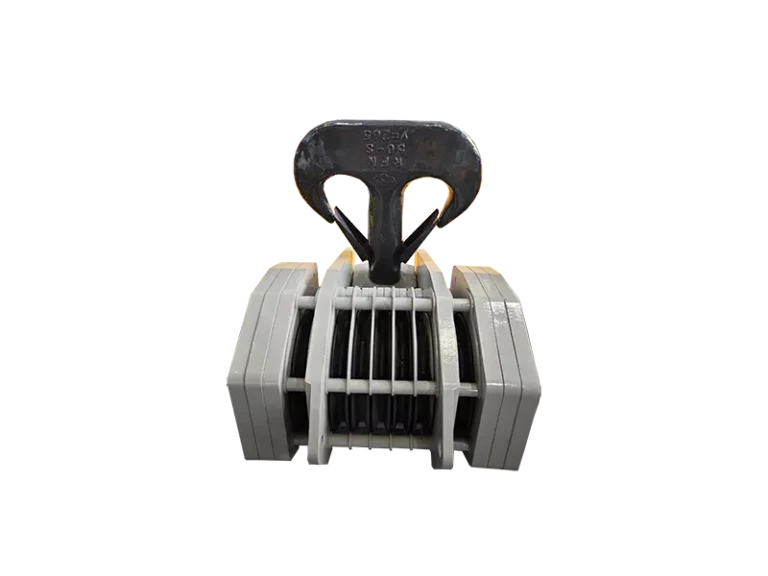
A hook block is an integrated hoisting assembly composed of a finished lifting hook, pulley, bearing, hook nut, crosshead and shell. As the final load-bearing execution unit of the crane lifting system, it cooperates with steel wires and hoisting mechanisms to complete material lifting operations.
Matched with DIN standard finished hooks, our hook blocks feature standardized assembly, stable operation and strong load-bearing capacity. They support single-hook and double-hook assembly forms, and can be adapted to different tonnages of cranes and hoisting equipment. All matched hook block accessories are processed with high precision, ensuring flexible pulley rotation, stable hook limit and no jamming during long-term cyclic work.
Hook blocks are widely used in overhead cranes, gantry cranes, port hoisting machinery, mining hoisting equipment and metallurgical industrial equipment, adapting to various indoor and outdoor heavy-duty hoisting working conditions.
Strict Quality Inspection & Quality Assurance System
All our forged lifting hooks and hook blocks implement comprehensive inspection and testing procedures to achieve zero-defect product quality. The core inspection items cover the whole production process:
- Visual Inspection: Check the hook surface for scratches, dents, cracks and other appearance defects.
- Dimensional Inspection: Verify key dimensions such as hook throat opening and shank size to comply with DIN standard requirements.
- Magnetic Particle Testing (MT): Detect surface and near-surface micro cracks of forgings.
- Ultrasonic Testing (UT): Inspect internal defects such as inclusions and hidden cracks inside the hook body.
- Hardness Test: Detect the hardness after heat treatment to ensure stable mechanical properties.
- Proof Load Test: Apply standard multiple working loads for static pressure testing to ensure no permanent deformation and structural damage.
We adhere to eco-friendly and sustainable production methods, with most of the factory’s electricity coming from green energy. Combined with a complete quality assurance system, we provide highly reliable, trusted DIN-standard lifting hooks and customized hook block solutions for global industrial customers.
Conclusion
DIN-standard single and ramshorn lifting hooks (including blanks and finished parts) and matched hook blocks are essential core components of modern industrial hoisting equipment. Through professional forging technology, standardized heat treatment, precise machining and strict testing procedures, these products achieve high strength, high toughness and high safety performance. Whether for light-duty daily hoisting or heavy-duty industrial lifting, they can provide stable and durable load-bearing support, and have become the mainstream choice for global crane supporting equipment with reliable quality and standardized specifications.